

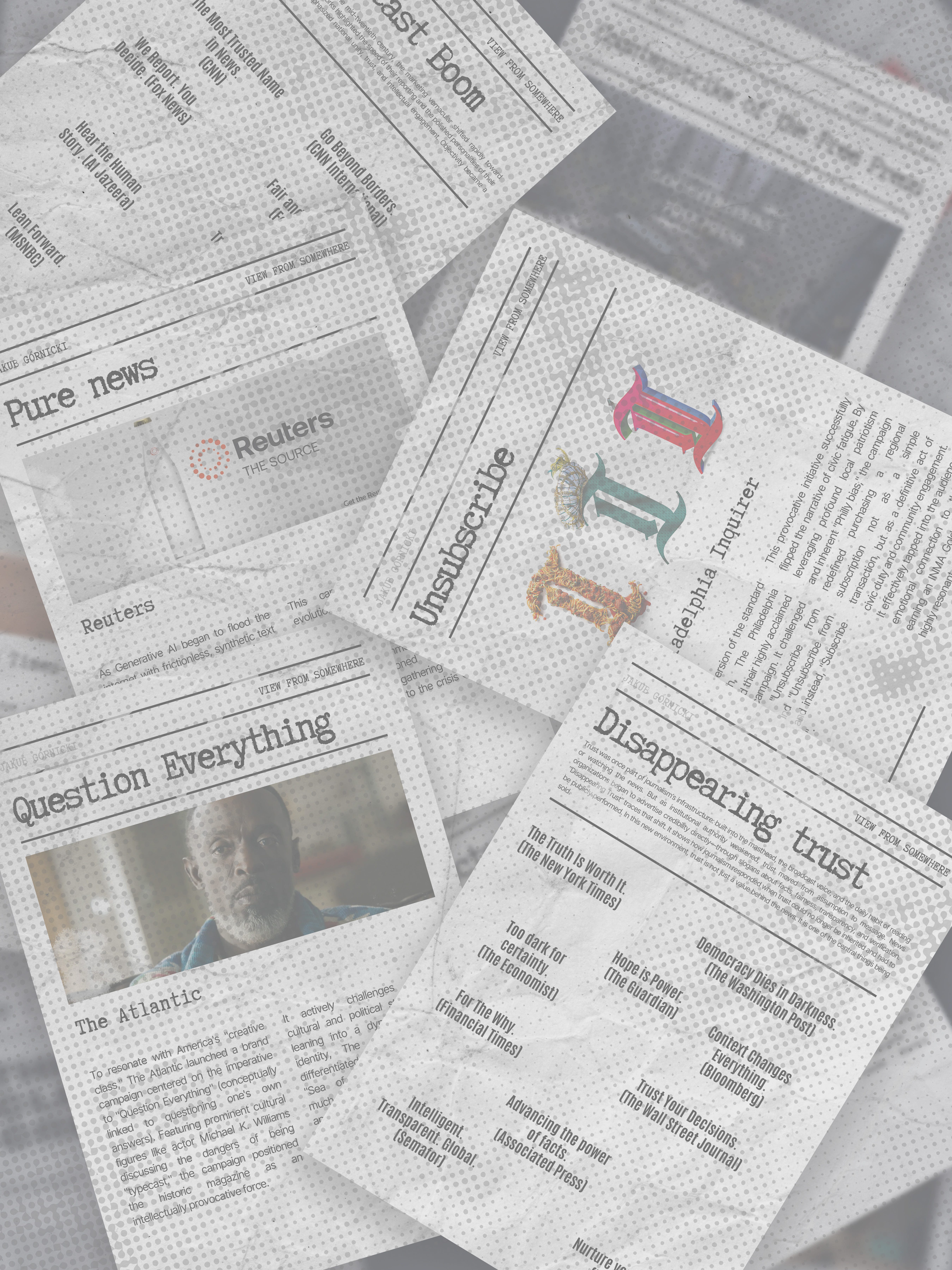
I built a wall of slogans before I wrote the report.
Not as decoration. As evidence.
Hundreds of lines from news organisations, stripped of their logos and brand colours, printed in black and white, pushed against each other until they stopped behaving like separate campaigns and started speaking as one anxious institution.
Believe us.
Trust us.
We are independent.
We are necessary.
We are not like the others.
The strange thing about reading more than 4,000 journalism campaigns is that, after a while, the individual slogans begin to disappear. The clever ones. The solemn ones. The expensive ones. The ones with the orchestral music behind them and the ones written in the clean language of a subscription prompt. Underneath them is the same small question.
Why should I trust you?
That question is now the title of my new INMA report: [*How News Brands Answer: Why Should I Trust You?*]
It comes from the exhibition I first showed at INMA Toronto. I wanted people to stand in front of that wall and feel the repetition physically. Not because the slogans were stupid. Most were not. Not because the values were false. Truth, independence, accountability, public service - these are still the right commitments.
The problem is more uncomfortable.
The words are worn out as claims.
When every serious outlet reaches for the same moral vocabulary at the same moment, that vocabulary stops distinguishing anyone. It becomes atmosphere. It becomes wallpaper. It becomes the white noise of a profession trying to reassure itself in public.
In the report, I argue that journalism has to move from trust claims to proof systems.
That sounds technical. It is not.
A claim tells the reader what to feel. A proof gives the reader something to inspect.
## The old infrastructure is gone
For most of journalism’s modern history, trust did not need to be marketed this aggressively because it lived somewhere else.
It lived in infrastructure. The newspaper arrived. The masthead was there because it had always been there. The local paper belonged to the street, the city, the breakfast table, the small daily ritual. You did not choose between endless sources. You chose the one that existed, the one your parents read, the one whose office you knew was somewhere nearby.
Broadcast moved that trust into a body. A voice. A face. A nightly ritual. The anchor became the trust mechanism, and in many cases the brand itself. Cable fractured that mechanism. The web finished the fracture. Platforms took the distribution layer. Search became the front door. Social became the place where people discovered stories with the source partly filed off.
Now even those doors are closing. Search answers before it sends. Social platforms no longer behave like generous distribution pipes. A growing number of people avoid news not because they cannot find it, but because they find too much of it. It is heavy, repetitive, emotionally expensive, and often detached from any sense of agency.
In that environment, journalism reaches for the biggest words it has.
Trusted.
Independent.
Fact-based.
Essential.
The instinct is understandable. It is also insufficient.
Trust has become a hygiene factor. The baseline. The wheels on the car. A newsroom announcing that it is trustworthy is like a restaurant advertising that it uses food. It may be true. It may be necessary. It is not a reason to choose you.
The old question was: do they know us?
The new question is harder: do they understand why we are necessary, and can they see the evidence?
## The claim has to become visible
The strongest campaigns in the recent INMA archive already understand this, even when they use different language for it.
They do not simply say “trust us.” They show the people who made the work. They show the method. They show the place. They bring readers into a product the publisher owns. They make the origin of the work legible in a synthetic media environment.
The New Zealand Herald put journalists at the centre of its trust campaign and measured whether audiences began to know their names. De Telegraaf placed reporters on billboards. Fædrelandsvennen answered reader questions about how reporting works in a public-facing format. The Press in New Zealand took regional identity seriously enough that place became a subscription argument. Nieuwsblad turned participation into something readers did through its app, not just something they saw in an ad. IOL put real journalists against AI fakes.
Different markets. Different budgets. One move repeated.
The invisible labour of journalism became visible.
That is what I call a proof system: the visible architecture that backs a trust claim before the reader is asked to pay, register, return, or believe.
It has six surfaces.
**People.** Make the journalists knowable. Not celebrity. Accountability. A byline should be a door into beat history, contact routes, correction norms, and why this person is reporting this story.
**Process.** Show the work on the highest-stakes journalism. Method notes, sourcing explanations, update logs, document links where possible, and plain language about what is known, contested, or still uncertain.
**Place.** Prove presence in the community or geography you claim. A local newsroom has to be visible as a local actor, not merely a generic product with neighbourhood tags.
**Participation.** Give readers a role that makes the journalism more useful, more accountable, or more visible. Not engagement theatre. A real act, connected to a product you own.
**Provenance.** Make origin legible. What was reported? What was translated? What was AI-assisted? What was generated? What was edited by a human? This cannot live only on a policy page nobody reads.
**Product.** Keep the promise daily. If the campaign says “human reporting” and the author pages are empty, the proof fails. If the campaign says “local” and the app feels generic, the proof fails. Product design is now brand design.
The point is not to add six decorations around the article page. The point is to force brand, editorial, product, audience, and subscription teams to admit they are now working on the same public object.
The promise is no longer above the journalism.
The promise is the journalism made visible.
## AI prices the generic at zero
AI makes this urgent because it changes the economic meaning of generic work.
A machine can write a plausible summary. It can produce a plausible article. It can imitate a serious editorial register. It can draft a brand manifesto about truth, democracy, facts, independence, and trust in any language, at any length, for almost no marginal cost.
This is not the deepest threat because the machine is brilliant. It is a threat because it has finally priced the generic correctly.
At zero.
Every piece of journalism marketing that depends on generic trust language now sits inside that price collapse.
What cannot be cheaply generated is the accountable human process behind the work. Who went there? Who called the source? Who checked the document? Who signed their name? Who corrected the story? Who can be reached when something is wrong? Who is known in the place where the reporting happens?
This is why I keep returning to the human body in journalism.
Not as sentiment. As evidence.
The reporter is not only a production credit. The byline is becoming a trust surface. The methodology box is becoming brand. The correction log is becoming public architecture. The newsroom’s presence in a place is becoming a moat.
The human is not the decoration around the journalism.
The human is part of the proof.
## The paywall is where the promise often dies
There is one place where this contradiction becomes especially visible: the paywall.
The top of the funnel in journalism marketing often carries the grand language. Democracy. Truth. Courage. Independence. Public service. Then the reader reaches the moment of conversion and the brand collapses into the same retail script as everyone else.
Register to keep reading.
Try one month for 99 cents.
Cancel anytime.
The civic register disappears exactly when the reader is closest to making a commitment. The news organisation spends money persuading the reader that the work matters, then asks for money in a voice that could belong to any subscription product on the internet.
That is not only a conversion problem. It is a rhetorical break.
If the campaign says this journalism is necessary, the paywall should explain what the subscription makes possible. If the campaign says this work is human, the conversion moment should show the people and process behind it. If the campaign says this outlet is local, the product should make that local presence obvious. If the campaign says this work is independent, the funding and ownership structure should not be hidden three clicks away.
The moment of payment is not outside the brand.
It is where the brand is tested.
## Measuring proof
If the brand problem has changed, measurement has to change with it.
Awareness still matters. Recall still matters. Preference still matters. I am not arguing for a bonfire of existing metrics. But those metrics answer the old question. They tell you whether people know the name, remember the campaign, or feel more positive after seeing it.
A proof system needs another layer.
Did people use the evidence?
Did they click the author page? Did they open the “how we reported this” note? Did they read the source explanation? Did the journalist newsletter gain repeat readers? Did trust lift among people exposed to process content? Did a participation mechanic create an owned relationship rather than rented attention? Did the product surface that carried the promise become permanent after the campaign ended?
That last question matters most.
A campaign should not vanish when the media buy ends. If it reveals a proof signal that moves people, that signal should graduate into the product.
Campaigns, in this model, become laboratories for permanent trust surfaces.
## What journalism will have to promise next
I do not think journalism is finished.
I think one of its old languages is finished.
That is different. More useful. Less theatrical.
Every time journalism has lost an old source of authority, it has invented a new public promise. Print implied trust. Broadcast performed it. Cable weaponised objectivity. Digital defended democracy. Subscription funded independence. Now AI forces the next move: process has to become visible.
The next strong news brand will not be the one that says “trust” most beautifully.
It will be the one that can show why trust is deserved.
People you can know.
Methods you can see.
Places you can feel.
Origins you can verify.
Products that keep the promise after the campaign ends.
The report is available through INMA here: [How News Brands Answer: Why Should I Trust You?]
I hope newsrooms read it less as a marketing document and more as a provocation to rebuild the public face of the work.
Because the audience is not asking for another slogan.
It is asking to see the work.
That is the task now.